


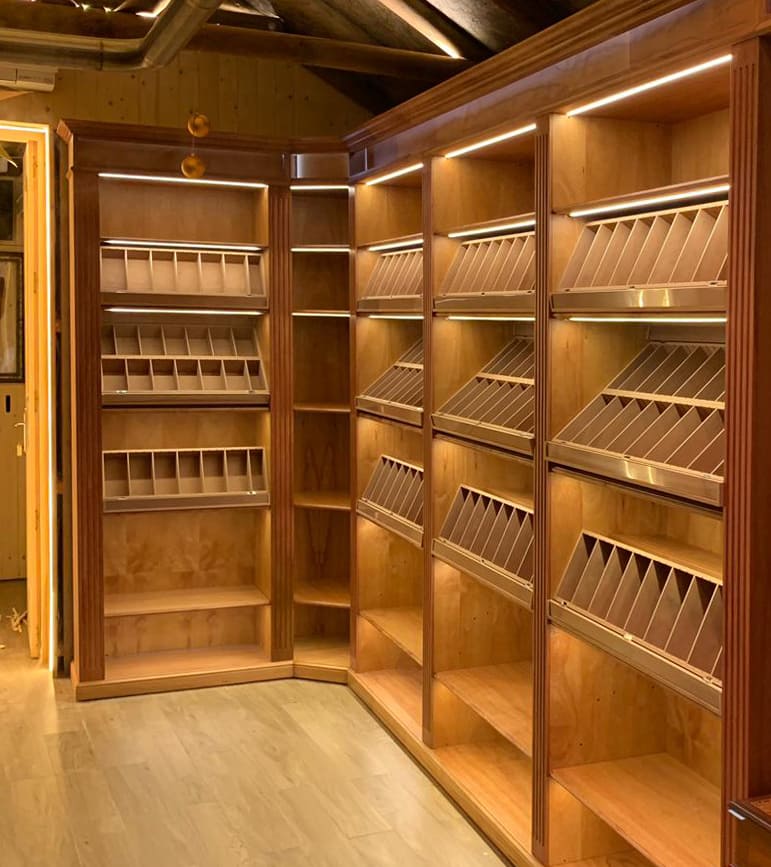
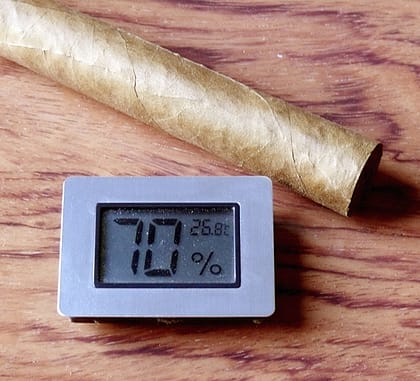
From the middle of the last century, when Zino Davidoff began importing tobacco into Switzerland, he observed that cigars arriving from Cuba tended to dry out. The local temperature conditions were very different, and humidity had to be adjusted accordingly. He found that cigars were properly preserved in an environment close to 70% relative humidity with an ambient temperature of around 20 °C.

Over time, these values became widely accepted as a standard in the world of cigars.

However, although this reference remains valid as a starting point, we now know that it is neither a fixed nor a universal figure, but rather the result of a very specific physical relationship between humidity, temperature and the actual amount of water in the air.

70% is not a rule, it is a consequence

When we talk about humidity in a humidor, we almost always refer to relative humidity (RH). This value indicates the percentage of water vapor present in the air compared to the maximum amount that air can hold at a given temperature.

It is important to understand that:

  • relative humidity does not measure how much water is actually present in the air,
  • but rather how “full” of water that air is in relation to its temperature.

For this reason, the same 70% relative humidity does not mean the same thing at different temperatures.

Absolute humidity and relative humidity: the key difference

To truly understand what happens inside a humidor, it is necessary to introduce the concept of absolute humidity, which expresses the actual amount of water vapor present in a given volume of air, usually measured in grams per cubic meter (g/m³).

From a physical standpoint, it has been proven that tobacco behaves optimally when the surrounding air contains an absolute humidity of approximately 12.0 to 12.5 g/m³.

When this amount of water is expressed as relative humidity at 20 °C, the resulting value is approximately 70% RH.

In other words, the well-known “70%” is not the goal in itself, but the way a specific amount of water in the air is expressed at a given temperature.

Temperature changes everything

Warm air can hold more water vapor than cold air. For this reason, the same amount of water results in different relative humidity values depending on temperature.

If the temperature drops and we keep the same relative humidity percentage, we are actually reducing the real amount of water available in the environment for the cigar.
If the temperature rises and we maintain that same percentage, we are increasing that amount.

This is where one of the most common mistakes in cigar preservation appears:
maintaining the same percentage without taking temperature into account.

Humidity in real figures

How much water is actually in the air of your humidor?

Let us imagine a humidor with an internal volume of 1 m³ (1,000 liters of air).
Beyond the percentage shown by the hygrometer, what truly matters is the actual amount of water contained in that air.

Same relative humidity, different amount of water

Temperature Relative humidity Actual water in the air (approx.) Effect on the cigar
18 °C 70 % RH ≈ 10.7 g Tendency to dry out
20 °C 70 % RH ≈ 12.1 g Optimal condition
22 °C 70 % RH ≈ 13.6 g Tendency to overhydrate

Although the percentage is the same, a difference of just 2 °C represents
more than a 13% variation in the actual amount of water present in the air.

The mistake of “always keeping the same percentage”

  • Winter (≈ 18 °C): 70% relative humidity means too little real water in the air. The cigar loses moisture.
  • Summer (≈ 22 °C): 70% relative humidity means excess real water. The cigar becomes overhydrated and expands.

The number is the same, but the effect on the cigar is completely different.

Adjusting relative humidity to maintain the same amount of water

If the goal is to maintain a constant amount of water in the air, equivalent to about 12 g/m³,
relative humidity must be adapted to temperature:

Temperature Recommended relative humidity
18 °C ≈ 82 % RH
20 °C ≈ 70 % RH
22 °C ≈ 62 % RH

Proper humidor control does not consist of fixing a single percentage, but of
measuring temperature and humidity together
and adjusting relative humidity according to the season.

Basic physics: the higher the temperature, the more water the air can hold;
to maintain the same real amount, the percentage must be lower.

Why keeping the same percentage does not work

In a real domestic environment, temperature changes throughout the year:

  • In winter, with temperatures around 18 °C, maintaining 70% relative humidity means the air contains less real water than necessary. The cigar tends to lose moisture.
  • In summer, with temperatures close to or above 22 °C, that same 70% means excess real water, which can lead to overhydration, uneven combustion and heavier flavors.

As we have explained, the percentage does not change, but the effect on the cigar does.

Adjusting humidity according to temperature

If the objective is to preserve cigars under stable conditions, the correct approach is not to focus on a single number, but on maintaining a constant amount of water in the air, adapting relative humidity to ambient temperature.

As a general guideline:

  • at lower temperatures, a higher relative humidity percentage is required,
  • at higher temperatures, that percentage should be reduced.

Always measuring temperature and humidity together is the only way to properly control a humidor.

Preserving is not imposing, it is balancing

A good humidor does not impose artificial conditions on the cigar. It recreates a stable environment, consistent with the nature of tobacco and with the physical laws that govern the relationship between air, humidity and temperature.

Seventy percent remains a valid reference, but only when one understands what it truly represents and under which conditions it applies.

The key is not the percentage, but the balance.

This is how we understand cigar preservation, and the principle that guides our work on every humidor we create.

Y si quieres más información sobre el mundo del tabaco...

burkinaderevist.com